
Tyre size guide
How to read your tyre size
Everything moulded on a tyre sidewall, explained in plain English. Car, 4WD, tractor and truck.
Type the size from your sidewall, or tap a number on the tyre to see what each marking means.
Decode any tyre size
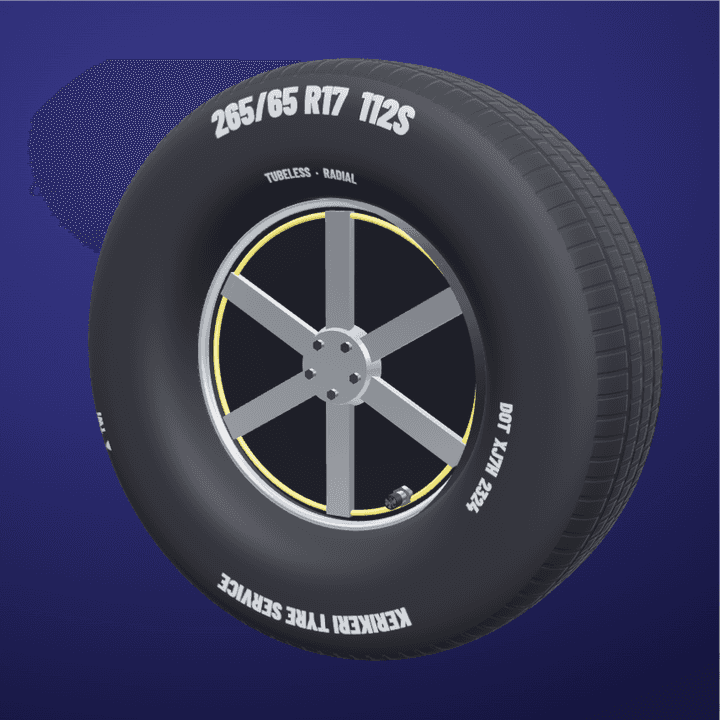
Drag to turn · pinch to zoom · tap a number
Car, SUV or 4WD tyre
265/65 R17 112S
Car, SUV or 4WD tyre: 265 mm wide with a 65% sidewall (about 172 mm), radial, for a 17-inch rim, carrying up to 1,120 kg per tyre at up to 180 km/h. Overall it’s about 776 mm (31 in) tall.
- 265 Width
- 265 mm wide, measured across the widest point of the sidewall.
- 65 Aspect ratio
- The sidewall is 65% as tall as the tyre is wide: about 172 mm.
- R Construction
- Radial: the cords inside run straight across the tyre. Almost every modern car, 4WD, truck and newer tractor tyre is radial.
- 17 Rim diameter
- Fits a 17-inch rim.
- 112 Load index
- 112 = up to 1,120 kg per tyre at its rated pressure.
- S Speed rating
- Speed rating S: built for a top sustained speed of 180 km/h when properly inflated and loaded.
More: Car & 4WD tyres
Read 265/65R17 112S in 30 seconds
Find the long code on the sidewall. On a typical 4WD or ute it looks like this:
265/65R17 112S
- 265
Width
Section width in millimetres, measured across the widest point of the sidewall. 265 means the tyre is 265 mm wide.
- 65
Aspect ratio
Sidewall height as a percentage of the width. 65 means the sidewall is 65% of 265 mm, about 172 mm. A lower number means a shorter, sportier sidewall.
- R
Construction
R means radial construction, which almost every modern road tyre uses. A dash or D means bias-ply.
- 17
Rim diameter
The wheel size it fits, in inches. A 17 fits a 17-inch rim, and must only go on a 17-inch rim.
- 112
Load index
A code for the most weight each tyre can carry at its rated pressure. 112 means 1,120 kg per tyre. Replacement tyres need at least the load rating your vehicle needs, which matters on heavy EVs, utes and 4WDs.
- S
Speed rating
A letter for the highest sustained speed the tyre is built for when properly inflated and loaded. S means 180 km/h. Tractor tyres use codes like A8 (40 km/h) and B (50 km/h).
Load index and speed rating tables
The two codes after the size. Replacement tyres should meet what your vehicle needs. If you’re unsure, call us and we’ll check.
| Load index | kg per tyre |
|---|---|
| 82 | 475 kg |
| 88 | 560 kg |
| 91 | 615 kg |
| 94 | 670 kg |
| 98 | 750 kg |
| 102 | 850 kg |
| 106 | 950 kg |
| 110 | 1,060 kg |
| 112 | 1,120 kg |
| 116 | 1,250 kg |
| 121 | 1,450 kg |
| 126 | 1,700 kg |
| Rating | Top speed |
|---|---|
| N | 140 km/h |
| P | 150 km/h |
| Q | 160 km/h |
| R | 170 km/h |
| S | 180 km/h |
| T | 190 km/h |
| H | 210 km/h |
| V | 240 km/h |
| W | 270 km/h |
| Y | 300 km/h |
“XL” or “Extra Load” means a reinforced tyre with a higher load index than the standard version of the same size. “LT” before the size means light-truck construction.
The other markings
DOT date code
The last four digits of the DOT code are the week and year it was made. 2324 means week 23 of 2024. It is often on one side of the tyre only.
TPMS valve
On most newer cars, 4WDs and EVs, a tyre pressure sensor sits inside the wheel behind the valve. Often you can spot it by a metal valve stem and nut. It warns you when a tyre is low.
Warning light on? See TPMS specialists.
Tread wear bars
Small raised bars across the bottom of the main grooves, marked by a triangle or “TWI” on the shoulder. When the tread is worn level with them, the tyre is due for replacement. The NZ legal minimum is 1.5 mm of tread.
The rule from NZTA: at least 1.5 mm of tread in the main grooves, all the way around the tyre. Winter tyres need at least 4 mm. More tread grips better, especially in the wet. Source: NZTA, tyres (opens in a new tab).
M+S and the snowflake
M+S means the tread is designed for mud and snow. A mountain with a snowflake (3PMSF) means it has passed a severe-snow traction test.
Rotation arrow and “Outside”
Directional tyres have an arrow showing which way they must roll. Asymmetric tyres are marked “Outside” on the side that faces out.
Tractor & ag
Reading a tractor tyre: 420/85R38 141A8
- 420: width in millimetres
- 85: sidewall height, 85% of the width
- R: radial. A dash instead (e.g. 18.4-38) means bias-ply
- 38: rim diameter in inches
- 141A8: load index 141 (2,575 kg per tyre) at speed symbol A8 (40 km/h). Some tyres show a second pair, like 138B, for a lower load at 50 km/h
Older sizes use inches for the width: 16.9R38 is 16.9 inches wide, radial, for a 38-inch rim, and is the older equivalent of 420/85R38. IF and VF tyres can carry about 20% and 40% more load than a standard tyre at the same pressure.
Tread types
- R-1
- Agricultural lug. Deep lugs for traction in soft ground and cultivation. The standard farm tread.
- R-1W
- Agricultural lug, wet. About 20% deeper than R-1 for wetter, heavier soils.
- R-2
- Deep lug. Very deep tread for rice paddies and cane fields. Rare in Northland.
- R-3
- Turf. Shallow, closely spaced tread that’s gentle on pasture, lawns, golf courses and orchard rows.
- R-4
- Industrial. Middle ground for loaders and backhoes that work on concrete, gravel and grass.
Truck, bus & light truck
Reading a truck tyre: 295/80R22.5 152/148M
- 295/80R22.5: 295 mm wide, sidewall 80% of the width, radial, for a 22.5-inch tubeless rim
- 152/148: load index running single (3,550 kg) and running as a dual pair (3,150 kg each)
- M: speed rating, 130 km/h
- 11R22.5: an older style. 11 inches wide, radial, 22.5-inch rim, with no aspect ratio shown
- LT265/75R16 123/120Q: light-truck construction, single and dual load indexes, rated to 160 km/h
4WD flotation sizes
33x12.50R15 is about 33 inches tall overall, 12.5 inches wide, radial, for a 15-inch rim. It’s common on lifted 4WDs. After a size change, an alignment protects the new tyres.
Tyre size questions
Still not sure? Read it out to us on 09 407 7168.
What does 265/65R17 mean?
It’s a tyre 265 mm wide, with a sidewall 65% as tall as it is wide (about 172 mm), of radial construction, made for a 17-inch rim. The load index and speed rating usually follow, e.g. 112S: up to 1,120 kg per tyre and 180 km/h.
Where do I find my tyre size?
It’s moulded on the sidewall of the tyre. Your vehicle’s recommended size is also usually on a placard inside the driver’s door jamb or in the owner’s manual.
How do I tell how old my tyres are?
Find the DOT code on the sidewall. The last four digits are the week and year of manufacture: 2324 means week 23 of 2024. It may only be on one side of the tyre.
What is the legal minimum tread depth in New Zealand?
NZTA requires at least 1.5 mm of tread depth in the main grooves, all the way around the tyre. Tread wear bars are moulded at about 1.6 mm, so when the tread is level with them the tyre is at the limit. More tread gives better grip, especially in the wet. See NZTA: tyres (opens in a new tab).
What does 420/85R38 mean on a tractor tyre?
420 mm wide, a sidewall 85% of the width, radial, for a 38-inch rim. It’s the metric equivalent of the older 16.9R38 size. A load and speed code such as 141A8 means up to 2,575 kg per tyre at up to 40 km/h.
What do R-1, R-3 and R-4 mean?
They’re tractor tread types. R-1 is the deep agricultural lug for soft ground and cultivation, R-3 is a shallow turf tread that’s gentle on grass, and R-4 is an industrial tread for loaders that work on hard surfaces and grass.
What do the two load numbers on a truck tyre mean, like 152/148?
The first is the load index when the tyre runs single (152 = 3,550 kg). The second is the load index for each tyre when run as a dual pair (148 = 3,150 kg).
Can I fit a different tyre size?
Sometimes, but the overall diameter, load index and speed rating all matter, and changes can affect your speedometer, ABS and warrant of fitness. Call us on 09 407 7168 and we’ll check what suits your vehicle.
Know your size? Call us for a price.
Open Mon–Fri 8am–5pm at 13 Mill Lane, Kerikeri. 24/7 callouts, on farm or roadside.